




RCS New Update: Understanding Dynamic Agent Reach Control (India)
-
 By Super Admin
 - Management
- Jan 29, 2026
- 4 minutes read
- 2,532 Views
Google is taking another important step to make RCS for Business more reliable, user-friendly, and spam-free in India. With the introduction of Dynamic Agent Reach Control, brands will now be encouraged to focus more on message quality rather than just message volume.
Let’s break this update down in simple terms so you can clearly understand what’s changing, why it matters, and how it impacts your RCS campaigns.
What Is Dynamic Agent Reach Control?
Dynamic Agent Reach Control is a reputation-based system introduced by Google for promotional RCS messages in India.
In simple words:
The better your RCS messages perform, the more users you can reach.
Google will now control how many new, unique users an RCS agent can send promotional messages to, based on its engagement quality and reputation.
When Does This Update Apply?
- Effective Date: 7th January 2026
- Applicable To:
Promotional RCS traffic in India - Not Applicable To:
Transactional messages
OTP messages
So, critical communication like OTPs and transaction alerts will continue as usual without any restriction.
How Does Dynamic Agent Reach Control Work?
Google evaluates each RCS agent on a 28-day rolling window and assigns a Reputation Tier:
- Low: 1 Million Users
- Medium: 25 Million Users
- High: 300 Million Users
Based on this tier, Google decides:
- How many unique users you can reach
- How fast your reach can grow
Reputation Tiers Explained
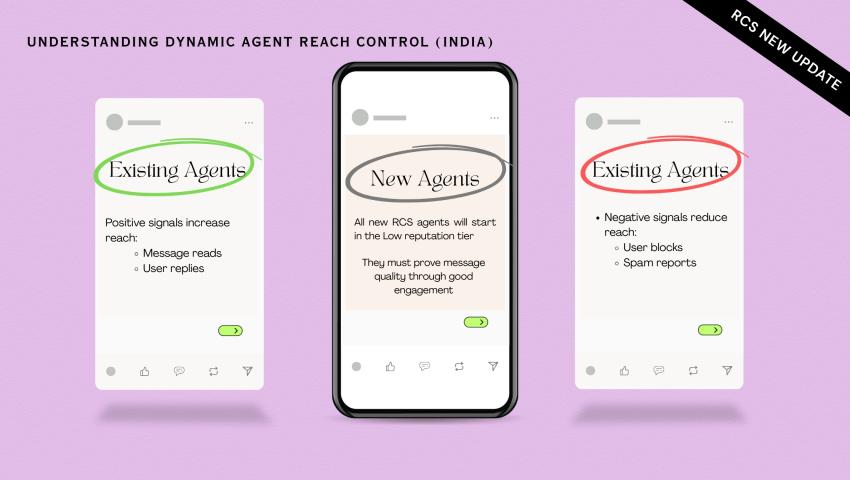
New Agents
- All new RCS agents will start in the Low reputation tier
- They must prove message quality through good engagement
Existing Agents
- Existing agents will be evaluated daily
- Positive signals increase reach:
- Message reads
- User replies
- Negative signals reduce reach:
- User blocks
- Spam reports
In short, user behavior directly impacts your campaign reach.
Reach Limits: What Exactly Is Restricted?
The limits apply to:
- Number of distinct (unique) users
- Not total message volume
Existing frequency limits (messages per user per 28 days/month) remain unchanged.
Example:
If a Low-tier agent can:
- Reach 1 million unique users
- Send 2 promotional messages per user in 28 days
Maximum messages allowed:
1,000,000 users × 2 messages = 2,000,000 messages
Similarly, a Medium-tier agent reaching 25 million users with 4 messages per user can send up to:
100 million promotional messages in 28 days
Important Exception: User-Initiated Messages
Good news for customer support teams
If a user starts the conversation, the agent can always reply:
- These replies are not counted in reach limits
- Support and two-way conversations will never be blocked
This ensures a smooth customer experience at all times.
What Happens If You Exceed the Limit?
If an agent crosses its allowed unique user limit within the 28-day window:
- The platform will return:
- Error Code: 704
- Channel Error Code: 429
- Error message:
“Rate limit hit – You have reached the maximum number of times that this request can be made in a given time.”
This acts as a safeguard to prevent excessive or low-quality messaging.
Why Google Introduced This Update
Google’s goal is to:
- Reduce spam and unwanted promotions
- Improve user trust in RCS messages
- Encourage brands to send relevant, engaging, and valuable content
- Build a sustainable RCS ecosystem in India
Simply put:
Quality > Quantity
What Should Brands Do Now?
To stay compliant and grow your reach:
- Focus on engaging content
- Avoid excessive promotional blasts
- Respect user preferences
- Monitor engagement metrics regularly
- Reduce spam complaints and blocks
Brands that prioritize user experience will naturally move to higher reputation tiers and enjoy greater reach.
Need Help or Clarification?
If you have questions about this update or how it affects your RCS campaigns, reach out to us. Our team is available to support you through this transition.
Final Thoughts
Dynamic Agent Reach Control is a positive change for both users and brands. It rewards meaningful communication and ensures RCS remains a powerful, trusted messaging channel in India.
If you focus on value-driven messaging, this update works in your favor